The pour-over.
It is considered the best coffee-brewing method by many, pretentious by most. What makes a good pour-over? What makes a pour-over so good? And what are the downfalls of this coffee brewing method?
These are the questions I sought to answer when writing this particular post. I compiled information from my work experience at Margie's, from various videos, and from some websites, all of which I will link to throughout my writings.
What is a Pour-over?
At it's most basic, a pour-over is the process of pouring hot water over ground coffee so the coffee extracts equally and slowly, resulting in a cup of coffee that accurately showcases all the different depths of flavor in the beans. There are multiple different tools that can be used, but at it's core it's quite simple. I personally have a pour-over carafe, rather than something like a V60 which is placed over an individual cup. In general, the coffee is placed in a cone-like filter and drained.
How do I do a Pour-over?
This video from James Hoffman explains one of the methods used to get the best quality cup of coffee from a v60:
I also received specific training in pour-overs from the owner of Harbinger. Here is a short run-down of what he discussed with me and my coworkers:
Why a Pour-over?
The general opinion is that the pour-over creates a lighter, more even extraction rather than something like a French Press, which produces a more oily and dense coffee. Pour-overs are also generally quick and easy to do, and it requires almost no special equipment to make it a quality cup.
A side-note on grind size:
One of the biggest variables in coffee brewing is the size of the coffee grounds. Some methods are better when the coffee is coarse, and others are meant for fine-ground beans. This can be tricky to control with a cheap spice-grinder-type coffee grinder. Because I wanted this guide to be for people at home without access or money to acquire any particularly special equipment, I wanted to steer away from discussing grind size beyond fine, coarse, or medium.
It is considered the best coffee-brewing method by many, pretentious by most. What makes a good pour-over? What makes a pour-over so good? And what are the downfalls of this coffee brewing method?
These are the questions I sought to answer when writing this particular post. I compiled information from my work experience at Margie's, from various videos, and from some websites, all of which I will link to throughout my writings.
What is a Pour-over?
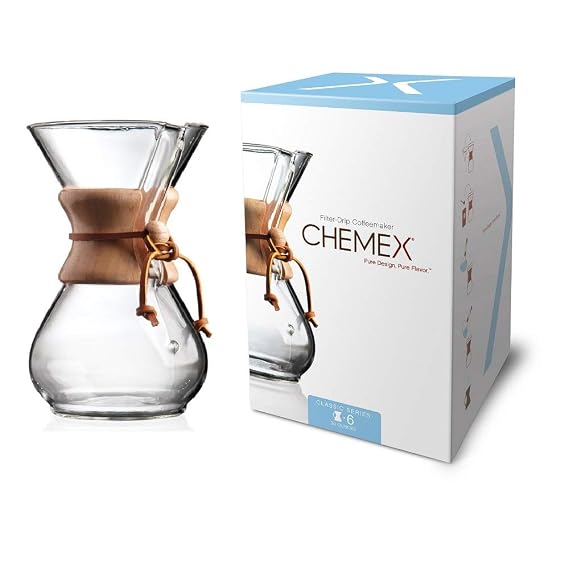 |
| This Chemex is a pour-over carafe. |
How do I do a Pour-over?
This video from James Hoffman explains one of the methods used to get the best quality cup of coffee from a v60:
 |
| The v60 can be placed over a cup rather than needing the carafe. |
I also received specific training in pour-overs from the owner of Harbinger. Here is a short run-down of what he discussed with me and my coworkers:
- The water needs to be just below or at boiling point, in Greeley, it can't get over about 204 degrees Fahrenheit
- The water to grounds ratio should be around 16.1::1. So we use 21 g of coffee and 355g of water
- Wet down the filter and rinse it to remove paper particles and the heat up the v60.
- Pour the first 50g of water within 30 seconds, and let it bloom.
- Blooming is when gasses are being released. By stirring these 50g of water around, we are producing equal extraction and releasing the gasses that prevent extraction.
- After 30 seconds, pour the rest of the 305g over the grounds in a slow, circular motion.
- Moving the water stream around adds turbulence, which also creates a more even extraction
- Slosh the water in the v60 around for a second to create an even bed of grounds
Main factors in a pour-over:
- Grind size. In this Stumptown Coffee blog post, they discuss the importance of a proper grind size. Most of the time you want it finer than you'd do for a drip coffee, but nowhere near powdered like espresso.
- The bloom pour. This is the 30 second pour I discussed earlier.
- Coffee to water ratio. When everything else is consistent and correct, this is the last variable you can adjust to make sure your coffee tastes the way you want it.
Why a Pour-over?
The general opinion is that the pour-over creates a lighter, more even extraction rather than something like a French Press, which produces a more oily and dense coffee. Pour-overs are also generally quick and easy to do, and it requires almost no special equipment to make it a quality cup.
A side-note on grind size:
One of the biggest variables in coffee brewing is the size of the coffee grounds. Some methods are better when the coffee is coarse, and others are meant for fine-ground beans. This can be tricky to control with a cheap spice-grinder-type coffee grinder. Because I wanted this guide to be for people at home without access or money to acquire any particularly special equipment, I wanted to steer away from discussing grind size beyond fine, coarse, or medium.
Comments
Post a Comment